

We established a scientific cooperation framework with the United Nations Office of Counter-Terrorism (UNOCT). The United Nations Office of Counter-Terrorism (UNOCT) leads and coordinates UN efforts to prevent and counter terrorism, while strengthening Member States’ capabilities through policy guidance, technical assistance and international cooperation. Its approach combines prevention, operational capacity-building and resilience against violent extremism, with human rights and the rule of law as fundamental principles. Within this collaboration, the KG Lab contributes advanced, trustworthy AI technologies designed explicitly for responsible, ethical and human-centered use.

The KG Lab signed a Memorandum of Understanding with ASIF (Supervisory and Financial Information Authority) establishing a formal framework for scientific cooperation. The agreement brings together ASIF’s institutional mission in financial intelligence and AML/CFT with the KG Lab’s expertise in advanced AI and automated reasoning. Its core research objective is the joint development of neuro-symbolic AI approaches for financial and economic analysis that are explainable, reproducible and transparent. This is particularly interesting for the joint interest of the Vatican and the Viennese research landscape to further human ethical uses of AI as found in Digital Humanism.
The signing therefore represents a unique milestone in the global Financial Intelligence Unit landscape, signaling the ambition of an institution at the forefront of financial intelligence to explore new, responsible AI-based instruments against financial crime. The cooperation opens concrete perspectives for joint research, prototypes, scientific publications, theses, workshops and future research projects. For the KG Lab, it is also a unique opportunity to confront cutting-edge research with real world, high-impact challenges in financial intelligence and crime prevention. The initiative strengthens TU Wien’s role in developing trustworthy and explainable AI technologies with direct institutional and societal impact.
Vadacode is a modern Integrated Development Environment for languages of the Datalog+/- family, such as Vadalog, and for rule-based logic programming in general. It is built as an extension for Visual Studio Code and provides developers and researchers with advanced features including syntax highlighting, error diagnostics, logical fragment detection, and schema inference. Vadacode also offers an interactive notebook mode and AI-assisted, copilot-style features to simplify the writing, understanding, and debugging of logic programs. Designed to bridge theory and practice, it makes logic-based data management more accessible for education, research, and real-world applications.

Our research laboratory was invited to contribute to the 9th Ministerial Conference on Financial and Sustainability Reporting (CFRR), hosted by the World Bank in Vienna. Our senior researcher, Dr. Eleonora Laurenza, delivered a keynote on the use of Knowledge Graphs and Generative AI in public financial management, showing how hybrid AI and semantic technologies can strengthen transparency, accountability, and sustainable development. Drawing on work from the KG Lab, she presented concrete applications of knowledge-graph methods for financial and sustainability reporting, with a particular focus on supporting developing countries through open, accessible digital innovation. The conference highlighted the growing need for collaboration between academia and government institutions to build more resilient and sustainable systems. TU Wien's contribution demonstrated how a research center of excellence can co-create value with international partners by applying AI-driven methods to real-world governance challenges. This engagement clearly reflects TU Wien's Third Mission: translating advanced research into meaningful tools for democratic governance and public-sector innovation. The exchange with World Bank officials and representatives from more than 50 countries reinforced the university's commitment to bringing scientific expertise directly into policy arenas where global change is shaped. Read the whole report about the conference here, and see what Eleonora’s presentation was all about here.

This interactive demo system provides intuitive explanations for Datalog reasoning, helping users understand how conclusions are derived from logical rules and data. The system offers visual provenance traces that show the complete derivation chain for query results, making it easier to debug programs, verify correctness, and gain insights into the reasoning process. By presenting explanations in an accessible, step-by-step manner, the tool bridges the gap between formal logic programming and practical understanding, serving both educational purposes and real-world debugging scenarios in knowledge graph and data integration applications.
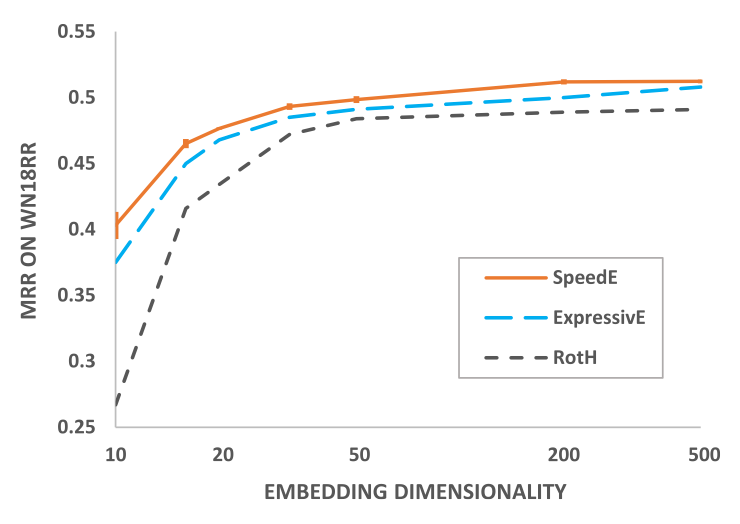
SpeedE is an Euclidean geometric knowledge graph embedding model designed to address the efficiency limitations of contemporary approaches. Operating entirely in Euclidean space, SpeedE achieves strong inference capabilities comparable to state-of-the-art models with dramatically improved efficiency: only 1/5 of the training time and 1/4 of the parameters compared to ExpressivE while achieving the same performance. The model proves that sophisticated geometric constructions and complex embedding spaces are not always necessary, addressing critical practical concerns for deploying KGE models in real-world applications. The dramatic reduction in training time and parameters makes KGE accessible for resource-constrained environments and enables deployment on edge devices and mobile platforms.
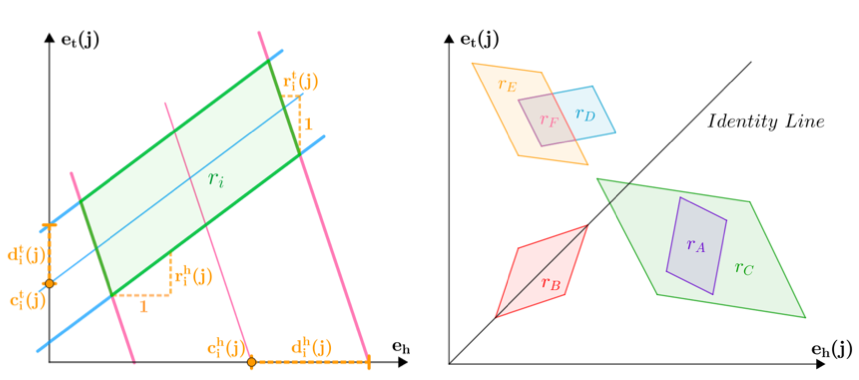
ExpressivE is a fully expressive knowledge graph embedding model designed for knowledge graph completion. By embedding entity pairs as points and relations as hyper-parallelograms in a virtual triple space, the model captures a rich set of inference patterns including composition and hierarchy jointly while providing interpretable representations. Unlike black-box models, ExpressivE allows researchers to understand learned logical rules through the spatial arrangement of parallelograms. The model is proven to be fully expressive, meaning it can represent any arbitrary knowledge graph with finite embedding dimensionality, and achieves competitive results on standard benchmarks while significantly outperforming existing models on WN18RR.
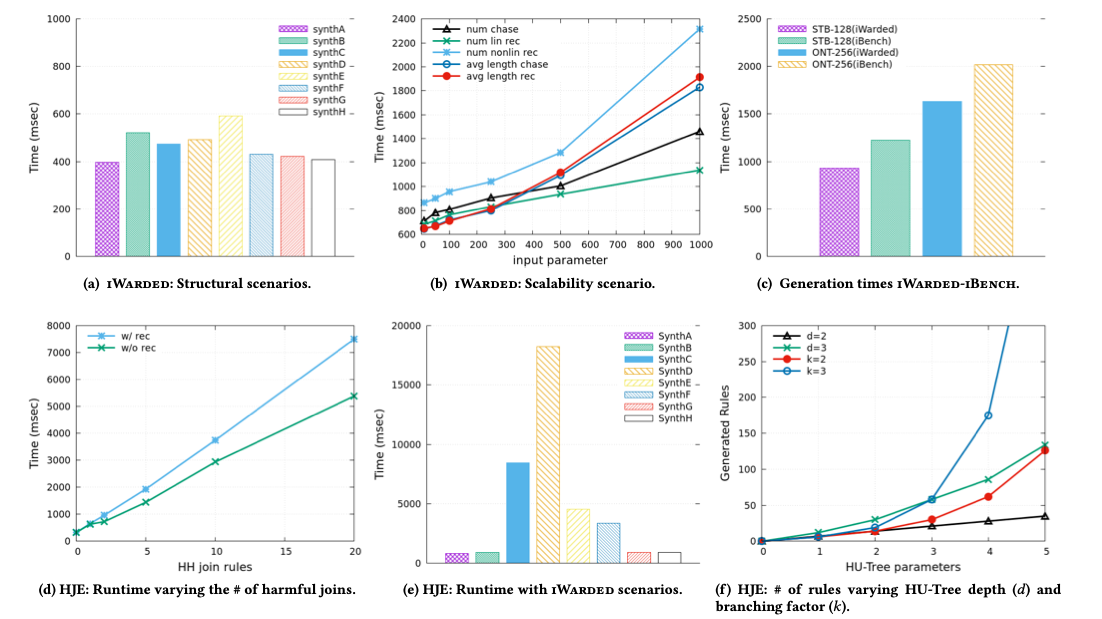
iWarded is a benchmarking system designed to generate synthetic but realistic reasoning scenarios for Warded Datalog+/- reasoning systems. The system allows users to generate warded, guarded, and shy Datalog+/- benchmark settings with control over numerous parameters including number of linear/non-linear rules, presence of harmful/harmless joins, recursion patterns, and existential quantification distribution. iWarded fills a critical gap in the evaluation of logic-based reasoning systems by enabling precise control over theoretical properties, ensuring reproducible experiments, and providing essential infrastructure for evaluating current and future systems as Datalog-based languages see increasing adoption in both academia and industry.
The Knowledge Graph Lab at TU Wien is part of the Database and Artificial Intelligence (DBAI) group at the Institute of Logic and Computation of the Faculty of Informatics. It is funded by the Vienna Science and Technology Fund (WWTF).

For inquiries please contact Dr. Emanuel Sallinger at <sallinger@dbai.tuwien.ac.at>.